Hi, I’m Azim Uddin

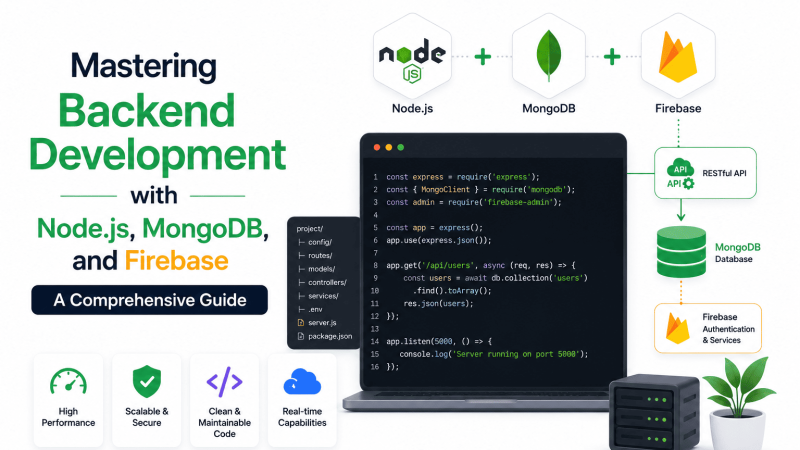
Mastering Backend Development with Node.js, MongoDB, and Firebase: A Comprehensive Guide

Introduction to Backend Development with Node.js, MongoDB, and Firebase Modern backend development demands a stack that balances performance, scalability, and real-time capabilities. Node.js, MongoDB, and Firebase together provide a robust foundation for building data-driven applications. Node.js offers an asynchronous, event-driven runtime ideal for handling concurrent requests, while MongoDB delivers flexible, document-oriented storage that scales horizontally. […]
Read More

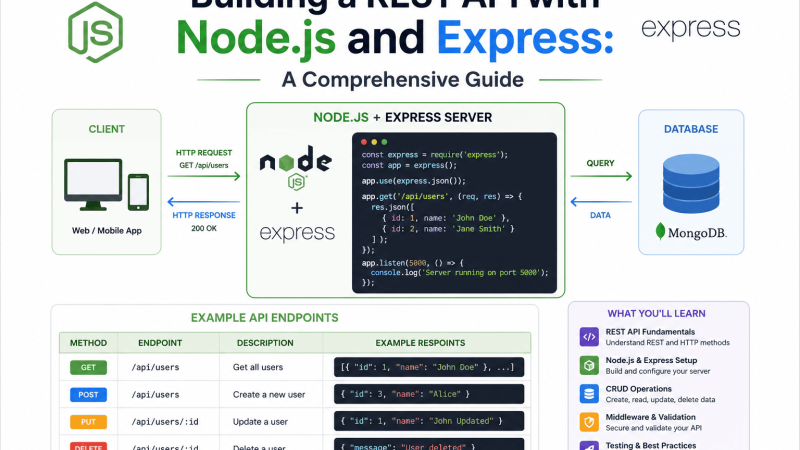
Building a REST API with Node.js and Express: A Comprehensive Guide

Introduction to REST APIs and Node.js What is a REST API? Key Principles and Constraints A REST (Representational State Transfer) API is an architectural style for designing networked applications that rely on stateless, cacheable communication via HTTP. It enables clients and servers to exchange resources—such as data objects or files—using standard HTTP methods like GET, […]

Read More

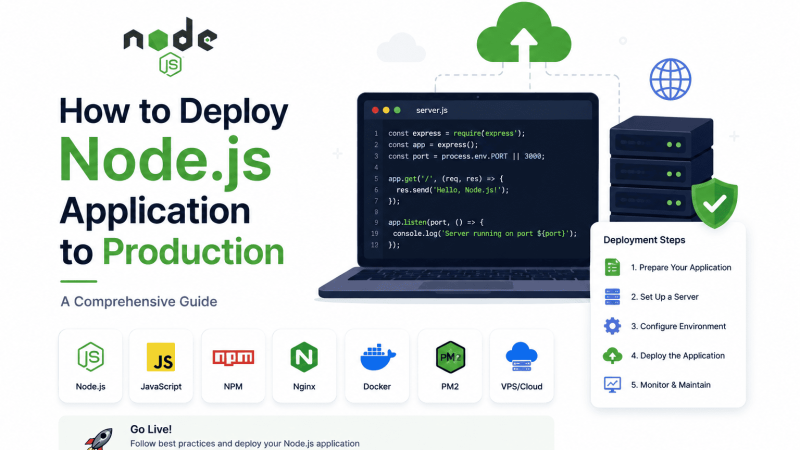
How to Deploy a Node.js Application to Production: A Comprehensive Guide

1. Preparing Your Node.js Application for Deployment Before pushing your Node.js application to a production server, you must ensure it is robust, secure, and optimized for real-world traffic. Production environments differ significantly from development setups, with stricter performance, reliability, and security requirements. Proper preparation minimizes downtime, prevents data leaks, and ensures your application scales gracefully […]

Read More

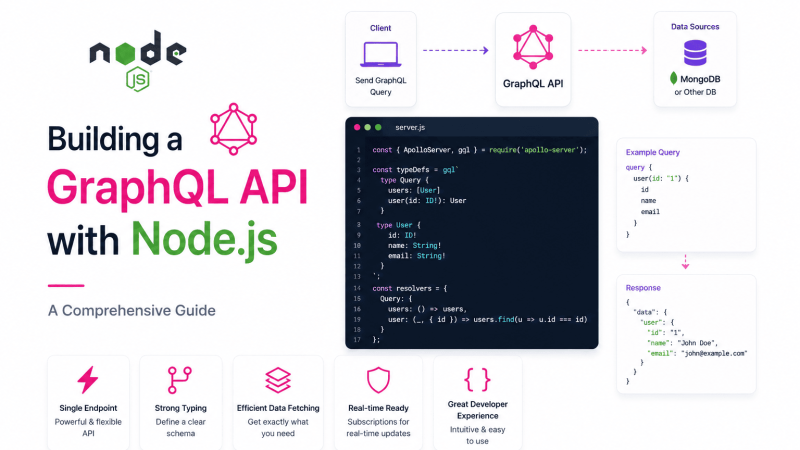
Building a GraphQL API with Node.js: A Comprehensive Guide

Introduction to GraphQL and Node.js What Is GraphQL and How It Differs from REST GraphQL is a query language and runtime for APIs, developed by Facebook in 2012 and open-sourced in 2015. Unlike traditional REST APIs, which expose multiple endpoints returning fixed data structures, GraphQL provides a single endpoint where clients can precisely request the […]

Read More

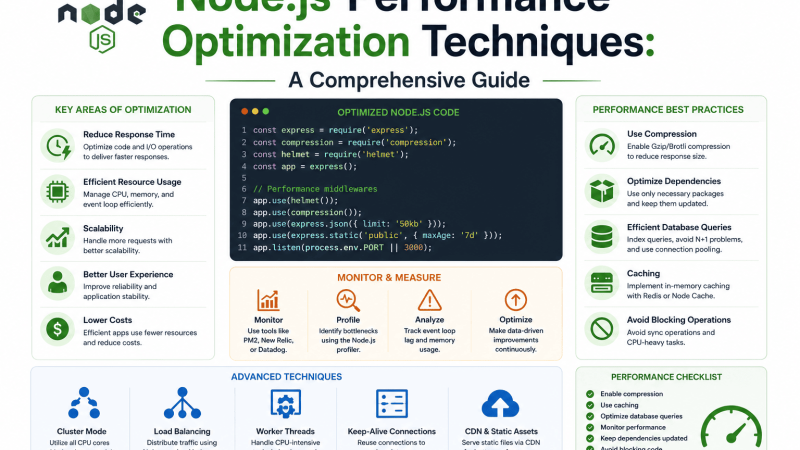
Node.js Performance Optimization Techniques: A Comprehensive Guide

Introduction to Node.js Performance Optimization Performance is a critical pillar of any production-grade Node.js application. A slow or unresponsive server directly degrades user experience, increases operational costs, and can lead to significant revenue loss. Node.js, built on Chrome’s V8 engine, is designed for high-throughput, non-blocking I/O operations, but it is not immune to performance degradation. […]

Read More

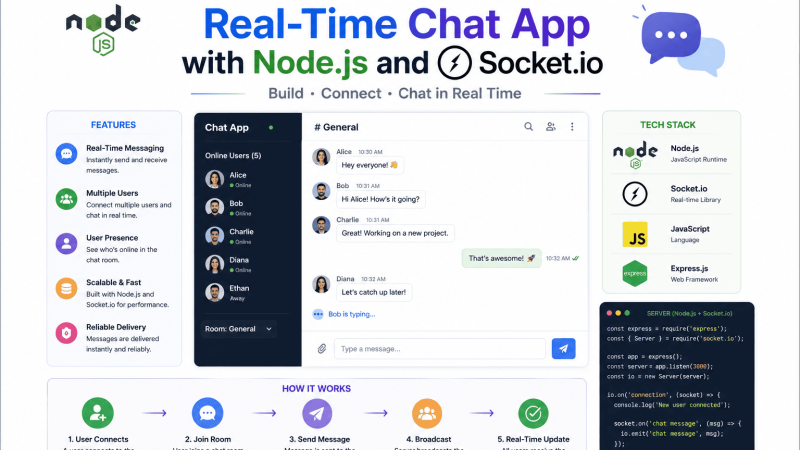
How to Build a Real-Time Chat App with Node.js and Socket.io

1. Introduction to Real-Time Chat Applications Real-time chat applications have transformed how individuals and organizations communicate online, enabling instantaneous message exchange without the perceptible delay typical of traditional web interactions. Unlike standard HTTP-based communication, where a user must refresh a page or wait for a periodic update, real-time systems push data to clients the moment […]

Read More

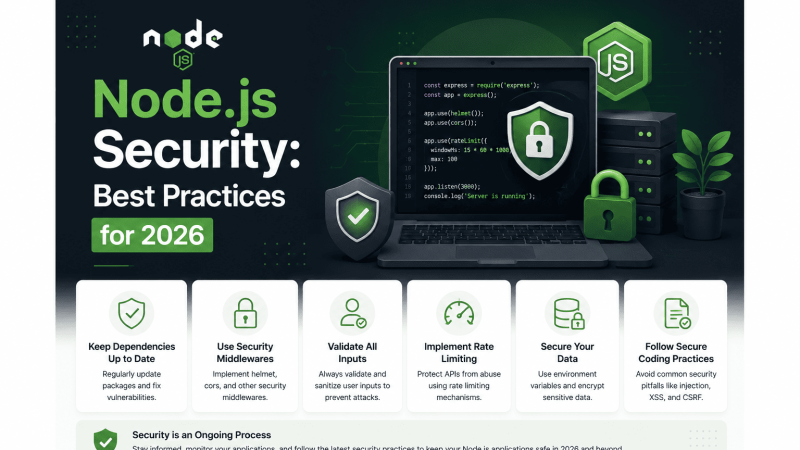
Node.js Security: Best Practices for 2026

Introduction: The Shifting Threat Landscape for Node.js in 2026 Node.js continues to power a vast portion of modern web applications, from API gateways to real-time services. As the ecosystem matures, so too do the tactics of adversaries. In 2026, the threat landscape is defined by increased automation, supply chain exploitation, and the weaponization of asynchronous […]

Read More

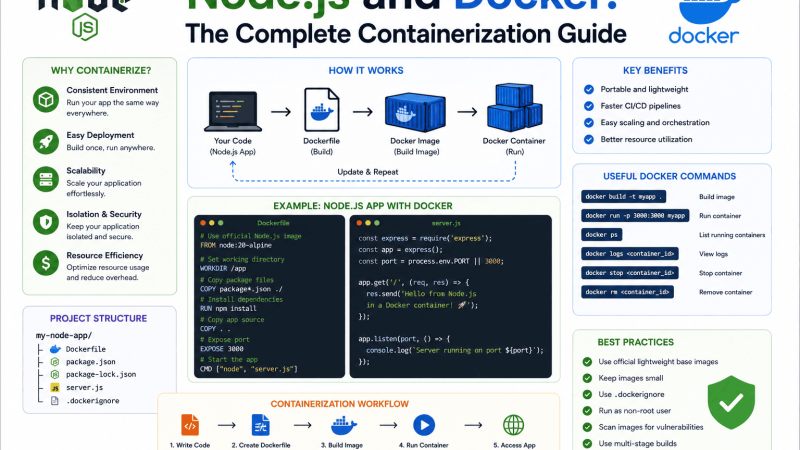
Node.js and Docker: The Complete Containerization Guide

Introduction to Node.js and Docker Containerization Combining Node.js with Docker represents a paradigm shift in how developers build, ship, and run applications. Node.js, with its event-driven, non-blocking I/O model, excels at handling concurrent requests and building scalable network applications. Docker, on the other hand, provides lightweight, portable containers that encapsulate an application and its dependencies […]

Read More

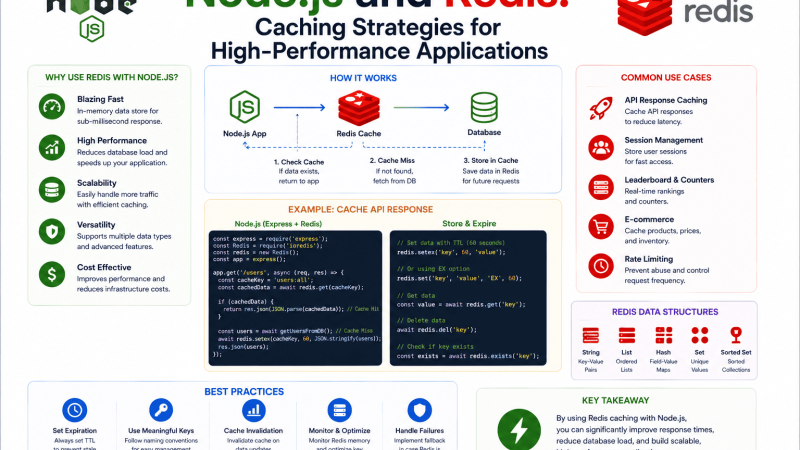
Node.js and Redis: Caching Strategies for High-Performance Applications

Introduction to Caching with Node.js and Redis Caching is a foundational technique for building high-performance Node.js applications. Without it, every user request that requires data—whether from a database, an external API, or a computation-heavy process—can introduce latency that degrades the user experience and strains backend resources. Node.js, with its event-driven, non-blocking architecture, excels at handling […]

Read More

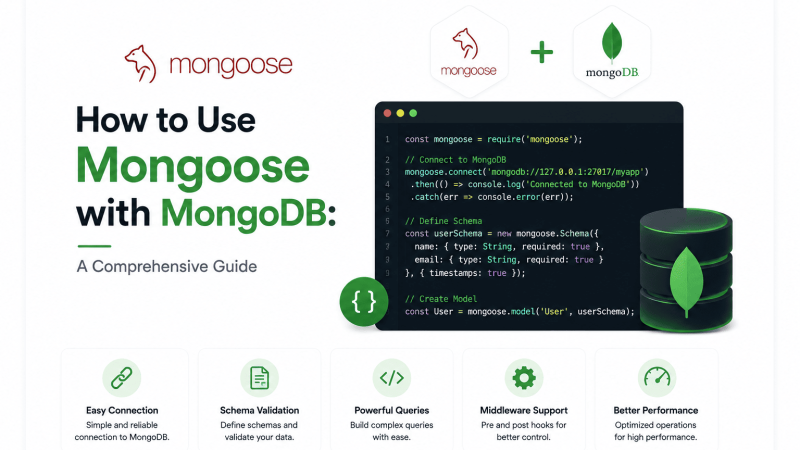
How to Use Mongoose with MongoDB: A Comprehensive Guide

Introduction to Mongoose and MongoDB When building Node.js applications that require persistent data storage, MongoDB emerges as a popular NoSQL database choice due to its flexibility and scalability. However, interacting directly with MongoDB using its native driver can become repetitive and error-prone, especially when managing data structure, validation, and relationships. This is where Mongoose enters […]

Read More