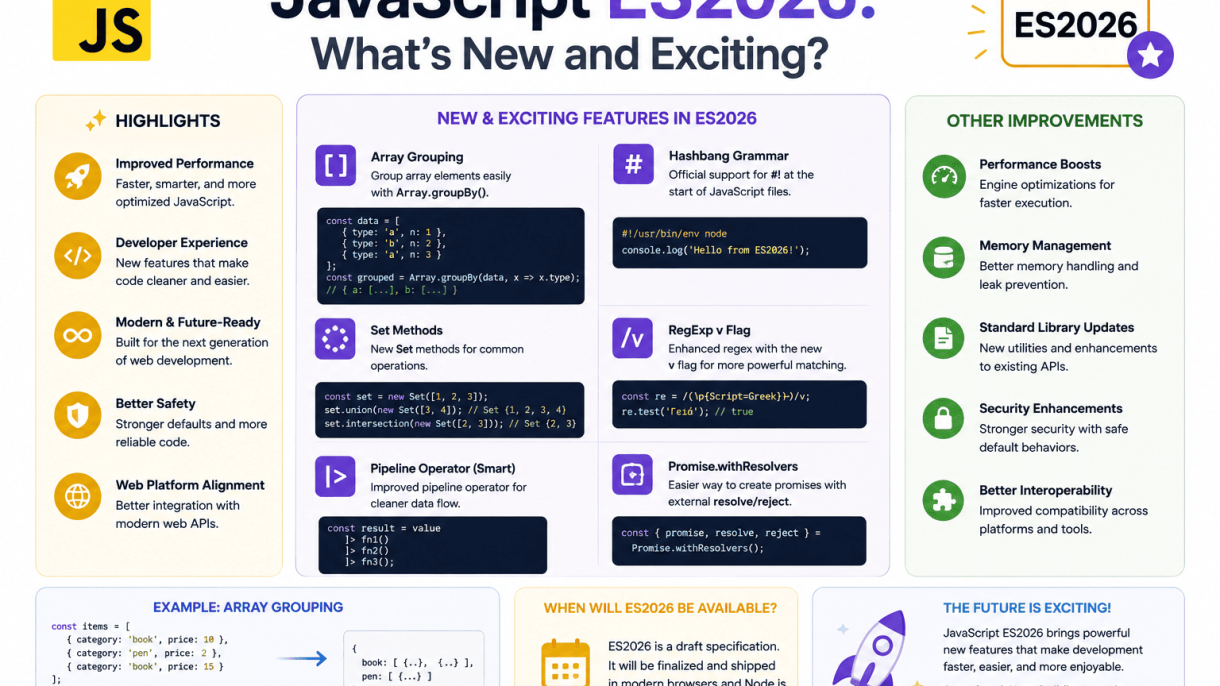

Introduction: The Evolution of JavaScript and ES2026
JavaScript has traveled a remarkable path from a simple scripting language for browser form validation to the backbone of modern web applications, server-side runtimes, and even desktop and mobile development. This transformation is driven by the ECMAScript specification, which defines the core syntax, semantics, and standard library of the language. Each year, the technical committee TC39—composed of representatives from major browser vendors, framework authors, and the broader developer community—reviews, refines, and approves new proposals. The result is a predictable, annual release cycle that keeps JavaScript evolving without breaking existing code. ES2026, formally known as ECMAScript 2026, is the next installment in this cycle, promising a set of carefully vetted features that address long-standing developer pain points while laying groundwork for future innovation.
How ECMAScript Versions Are Named and Released
Since ES6 (ECMAScript 2015) introduced the now-standard yearly cadence, each version is named after the year of its publication—hence ES2026, ES2025, ES2024, and so on. The naming is not arbitrary; it reflects the specification’s adoption by the ECMA General Assembly, typically in June. The process itself is rigorous and transparent. Proposals move through four stages, from Stage 1 (idea) to Stage 4 (finished), with each stage requiring concrete evidence of design feasibility, test coverage, and real-world implementation support in at least two major JavaScript engines. This ensures that only mature, well-understood features reach the final specification. Unlike some languages that release massive, disruptive changes, ECMAScript’s iterative approach favors small, incremental additions that maintain backward compatibility—a critical property for the world’s most widely deployed programming language.
Why ES2026 Matters for Modern Web Development
Modern web development is no longer just about DOM manipulation. Developers build complex stateful applications, real-time collaboration tools, data pipelines, and AI-driven interfaces, all running on JavaScript. ES2026 matters because it directly addresses the friction points that emerge in these demanding environments. For instance, improvements to asynchronous programming, data handling, and error management can reduce boilerplate, improve readability, and prevent subtle bugs. Additionally, as JavaScript expands into new domains—such as embedded systems, edge computing, and WebAssembly interop—the language needs primitives that are both expressive and performant. ES2026 delivers exactly that: features that feel natural to experienced developers while remaining approachable for newcomers. The specification also prioritizes developer ergonomics, meaning less time debugging cryptic syntax and more time focusing on product logic. For teams maintaining large codebases, these enhancements translate directly into lower maintenance costs and faster feature delivery.
What to Expect in This Article
In the following sections, we will unpack the most significant additions in JavaScript ES2026, explaining their syntax, use cases, and potential impact on your daily coding practice. You will learn about new built-in methods that simplify common operations, enhancements to existing patterns like promises and iterators, and any syntactic sugar that makes complex logic more readable. Each feature is presented with concrete, runnable examples and practical advice on when to adopt it—and when to stick with older patterns. We will also highlight potential pitfalls and browser support considerations, so you can confidently integrate these features into your projects today. By the end, you will have a clear roadmap for upgrading your skill set and codebase to take full advantage of ES2026. Whether you are a frontend specialist, a Node.js backend developer, or a full-stack engineer, this guide will help you stay ahead in the ever-evolving JavaScript ecosystem. Let’s dive in.
JavaScript ES2026: What’s New and Exciting?
The ECMAScript specification continues its steady, annual evolution, and ES2026 (formally ECMAScript 2026) is no exception. While it may not be a landmark release like ES6, the upcoming edition delivers a focused set of practical improvements that promise to streamline everyday coding. Developers will find the new features refreshingly pragmatic, targeting long-standing pain points in asynchronous workflows, array manipulation, and diagnostic clarity. Below, we break down the most impactful language additions you can expect to use in your projects.
The New Pipeline Operator (|>)
Function composition has historically been awkward in JavaScript, often leading to deeply nested parentheses that hurt readability. The pipeline operator offers a clean, linear way to chain function calls. Instead of writing fn3(fn2(fn1(value))), you can express the same logic as value |> fn1 |> fn2 |> fn3. This makes complex transformations read like a sequence of steps, improving both comprehension and maintainability. The operator also plays nicely with partial application via the placeholder token (^), allowing you to insert arguments at any position in a function call. Here is a practical example:
// Without pipeline
const result = JSON.stringify(parseUserInput(input).trim().toLowerCase());

// With pipeline
const result = input
  |> parseUserInput
  |> (^ => ^.trim())
  |> (^ => ^.toLowerCase())
  |> JSON.stringify;
This feature is especially valuable for data processing pipelines, ETL operations, and any scenario where multiple transformations are applied sequentially.
Array.prototype.atLast and atFirst Methods
Accessing the first or last element of an array has always been a bit verbose. The classic approach, arr[arr.length - 1], is error-prone and obscures intent. ES2026 introduces two intuitive methods that solve this cleanly:
arr.atFirst()– Returns the first element without mutating the array. Equivalent toarr[0], but more explicit and safe for empty arrays (returnsundefined).arr.atLast()– Returns the last element, eliminating the need for manual length calculations. For empty arrays, it returnsundefined.
These methods are not just syntactic sugar; they reduce common off-by-one errors and make code self-documenting. For example, in a queue implementation where you frequently peek at the most recent item, queue.atLast() is far clearer than queue[queue.length - 1]. They also support optional fallback arguments, so you can provide a default value when the array is empty: arr.atLast('none').
Improved Error Handling with Error Cause Chaining
Debugging deeply nested async operations often suffers from “error swallowing” – where a low-level failure is caught and rethrown without context, losing the original stack trace. ES2026 formalizes a solution through the cause property on the Error object. When you catch an error and want to wrap it with more contextual information, you can now pass the original error as the cause option:
try {
  await fetchUserData(id);
} catch (originalError) {
  throw new Error(`Failed to load user ${id}`, { cause: originalError });
}
When the outer error is logged, the cause chain is preserved, allowing you to trace through every layer of the failure. This is a game-changer for observability in production environments. The spec also includes a helper method, Error.prototype.causeChain(), which returns an array of all nested causes, making it trivial to inspect the full stack of failures in logging tools or error reporting dashboards. This feature encourages a best practice of always wrapping errors with context while never losing the root cause.
Together, these three additions represent a thoughtful evolution of the language. The pipeline operator improves code flow, the array methods simplify common tasks, and error cause chaining brings much-needed transparency to failure handling. ES2026 may be incremental, but its impact on developer experience is substantial.
JavaScript ES2026: What’s New and Exciting?
The ECMAScript 2026 specification (ES2026) continues JavaScript’s trajectory toward more expressive and resilient asynchronous programming. While not a sweeping overhaul, this update delivers targeted improvements that reduce boilerplate, clarify error handling, and make complex workflows more readable. For developers juggling multiple promises, streaming data, or deferred execution patterns, these additions are genuinely practical upgrades rather than theoretical conveniences.
Promise.withResolvers: A Cleaner Way to Create Deferreds
Historically, creating a manually resolvable promise (a “deferred”) required awkward scaffolding: you had to declare a promise, then separately capture its resolve and reject functions inside an executor callback. ES2026 introduces Promise.withResolvers(), a static method that returns an object containing { promise, resolve, reject } in one step. This eliminates the need for temporary variables or nested closures, making deferred creation both concise and less error-prone.
Consider the old pattern versus the new:
- Before:
let resolveFn, rejectFn; const p = new Promise((res, rej) => { resolveFn = res; rejectFn = rej; }); - After:
const { promise, resolve, reject } = Promise.withResolvers();
This is especially useful in event-driven code, such as waiting for a user action or a WebSocket message, where the promise must be resolved from outside the executor’s scope. The API is symmetric and reduces the chance of accidentally leaving a promise pending due to forgotten variable assignment.
New Promise.anySettled for Aggregated Results
ES2026 adds Promise.anySettled(), complementing the existing allSettled() method. While allSettled() waits for every promise to settle (resolve or reject) and reports their individual statuses, anySettled() returns as soon as any promise settles, providing an aggregated snapshot of that first settled outcome. This is not a race for the first resolution — it captures the first settlement regardless of whether it was a fulfillment or a rejection.
This utility shines in scenarios where you need early feedback from a set of operations, such as health checks across multiple servers. If one server responds (even with an error), you can immediately act without waiting for the slowest endpoint. The result is a single object: { status: "fulfilled" | "rejected", value? | reason? }.
| Method | Waits For | Returns | Use Case |
|---|---|---|---|
Promise.all() |
All promises to fulfill | Array of values (rejects fast on first rejection) | Parallel dependent tasks |
Promise.allSettled() |
All promises to settle | Array of status objects for each | Report on every operation |
Promise.anySettled() |
First promise to settle | Single status object of that first settlement | Early signal from any source |
Promise.race() |
First promise to settle | Value or reason of first settlement | Timeout or quickest result |
Note that anySettled() differs from race() because race() rejects if the first settled promise rejects, while anySettled() always returns a status object without throwing — giving you controlled handling of the early outcome.
Async Iteration with for-await-of and New Helpers
ES2026 refines async iteration by adding helper methods to AsyncIterator prototypes, mirroring the synchronous Array helpers. Now you can use map, filter, reduce, and forEach directly on async iterables, returning new async iterables or aggregated results. This removes the need to manually accumulate results in a for-await-of loop for common transformations.
For example, instead of:
const results = [];
for await (const chunk of stream) {
  if (chunk.length > 10) results.push(chunk * 2);
}
You can now write:
const results = await stream
  .filter(chunk => chunk.length > 10)
  .map(chunk => chunk * 2)
  .toArray();
These helpers are lazy — they only pull from the source as needed — which preserves memory efficiency for infinite or long-lived streams. The toArray() terminal method collects results, while other helpers like take(n) and drop(n) provide slicing without materializing the entire stream. Combined with for-await-of for manual control, ES2026 gives developers both declarative and imperative tools for asynchronous data processing, making complex pipelines far more readable and maintainable.
JavaScript ES2026: What’s New and Exciting?
The upcoming ES2026 specification (formally ECMAScript 2026) continues JavaScript’s steady evolution toward more expressive, ergonomic data handling. While not as headline-grabbing as a new syntax feature, this release packs a suite of smarter data structures that reduce boilerplate and clarify intent. The focus is on methods that either group, reorder, or inspect collections without mutating the original data—a boon for functional programming patterns and predictable state management.
Object.groupBy and Map.groupBy for Data Grouping
Grouping items by a criterion has long required manual loops or third-party libraries. ES2026 introduces two static methods that make this a one-liner:
Object.groupBy(items, callback)– returns a plain object where each key is a group name and each value is an array of matching items.Map.groupBy(items, callback)– returns aMap, which preserves insertion order and supports non-string keys (e.g., numbers, objects, or symbols).
The callback receives each item and returns the group key. A key practical difference: use Object.groupBy for simple string labels, but switch to Map.groupBy when your grouping logic yields numeric or object keys, or when you need guaranteed key order. Both methods are non-mutating and skip null or undefined items.
Array.prototype.toSorted, toReversed, and toSpliced
Historically, sort(), reverse(), and splice() mutated arrays in place, forcing developers to copy arrays manually to avoid side effects. ES2026 adds immutable counterparts that return new arrays:
| New method | Behavior | Old mutating equivalent |
|---|---|---|
toSorted(compareFn?) |
Returns a sorted copy; original unchanged. | sort() |
toReversed() |
Returns a reversed copy. | reverse() |
toSpliced(start, deleteCount, ...items) |
Returns a new array with items inserted/removed. | splice() |
These methods are especially valuable in React or Redux-style code, where immutability prevents subtle bugs. They also pair well with with() (already in ES2023) for updating a single index.
New Typed Array Methods for Binary Data
Typed arrays—the backbone of WebGL, WebAudio, and file parsing—receive a parallel set of utilities. ES2026 adds toSorted() and toReversed() to all typed array subclasses (e.g., Uint8Array, Float32Array). These return a new typed array of the same type, preserving the underlying binary format. Additionally, a fromBase64() and toBase64() pair lands on Uint8Array, eliminating the need for manual bit-shifting when converting binary data to and from base64 strings. This is a practical win for encoding buffers before sending them over WebSockets or storing them in localStorage.
Practical example: Grouping orders by customer status, then sorting each group without side effects.
const orders = [
  { id: 1, status: 'pending', amount: 50 },
  { id: 2, status: 'shipped', amount: 120 },
  { id: 3, status: 'pending', amount: 30 },
];

const byStatus = Object.groupBy(orders, o => o.status);
// byStatus = { pending: [order1, order3], shipped: [order2] }

const sortedPending = byStatus.pending.toSorted((a, b) => a.amount - b.amount);
// sortedPending = [order3, order1] — original orders array untouched
These additions signal a clear direction: JavaScript is doubling down on non-destructive, declarative data manipulation. For developers, that means less defensive copying, fewer bugs from accidental mutation, and code that reads closer to its intent. Whether you’re handling API responses, binary streams, or complex UI state, ES2026 gives you the tools to do it more cleanly.
JavaScript ES2026: What’s New and Exciting?
The upcoming ES2026 specification (formally ECMAScript 2026) continues JavaScript’s steady evolution, with a particular focus on making text processing more precise and less error-prone. While the release includes several quality-of-life improvements, the most impactful changes land squarely in regular expressions and string manipulation. These upgrades address long-standing pain points for developers working with international text, malformed data, and complex pattern matching. Below, we break down the three headline features you’ll want to adopt immediately.
The /v Flag for Extended Unicode Support
The new v flag (available alongside the existing u flag) revamps Unicode-aware regex. It introduces set notation and string properties directly inside character classes, making it far easier to match specific Unicode categories or ranges without verbose alternatives.
- Set operations: Use
--(subtraction) and&&(intersection) within brackets. Example:/[p{Script=Greek}--[p{Letter}]]/vmatches Greek symbols that are not letters. - Nested character classes: You can now write
/[p{Decimal_Number}&&[0-9]]/vto match only ASCII digits that are also decimal numbers, avoiding false positives. - Improved escaping: The
vflag disallows ambiguous escapes (likepwithout a property), forcing clearer, more maintainable patterns.
This flag is particularly valuable for parsers, syntax highlighters, and any tool that must handle multilingual input. It reduces the need for external libraries and complex lookahead workarounds.
String.prototype.isWellFormed and toWellFormed
Unicode strings can contain lone surrogates—invalid code units that appear when data is corrupted or partially transmitted. ES2026 adds two direct methods to String.prototype to handle this gracefully:
isWellFormed(): Returnstrueif the string contains only valid Unicode scalar values, andfalseif it contains any lone surrogates (e.g.,"uD800".isWellFormed()→false).toWellFormed(): Replaces every lone surrogate with the Unicode replacement character (U+FFFD), ensuring the output is always valid. Example:"auD800b".toWellFormed()→"a�b".
These methods are essential for JSON serialization, network protocols, and database storage where malformed strings can cause cryptic errors. They replace manual regex checks and offer a performance boost over polyfills.
New Regex Match Indices (d Flag) Enhancements
The d flag, which adds indices to match results, receives two significant updates in ES2026. Previously, indices only provided start/end positions for the full match and capture groups. Now, it also covers:
| Feature | What it adds | Example |
|---|---|---|
| Named group indices | Indices for named capture groups are exposed under indices.groups. |
/(?<year>d{4})/d.exec("2026").indices.groups.year → [0,4] |
| Lookbehind and lookahead captures | Indices for assertions that capture (e.g., (?=(d+))) are now included, not just the main pattern. |
/(?=(d+))/d.exec("abc123").indices[1] → [3,6] |
These enhancements simplify building tokenizers, syntax highlighters, and parsers that need precise offsets for sub-expressions. You no longer have to manually recompute positions from string lengths, which is especially error-prone with multi-byte Unicode characters.
Together, these three additions make ES2026 a quiet but powerful release for anyone who works with text at scale. The v flag modernizes regex syntax, the string methods harden data pipelines, and the d flag enhancements provide surgical precision. Check your runtime’s support (Node.js 22+, modern browsers) and start integrating these features today—they will save you hours of debugging and rewrite effort.
Module System Advancements and Interoperability
JavaScript’s module system has long been a patchwork of community solutions and standards, but ES2026 introduces a significant leap forward in both capability and cohesion. The focus is no longer just on loading code, but on loading it intelligently, with explicit type awareness and smoother transitions between the two dominant module formats. For developers juggling JSON configuration files, WebAssembly, or mixed CommonJS/ESM codebases, these changes reduce friction and unlock new patterns for application architecture.
Import Attributes: Importing JSON and Other Types
One of the most anticipated additions is the standardization of import attributes (formerly known as import assertions). This syntax allows you to declare the expected type of a module at the import site, which is critical for safely importing non-JavaScript resources. While JSON modules have been experimentally supported in bundlers for years, ES2026 formalizes this with a clear, enforced syntax that prevents ambiguous or malicious content from being executed as code.
Consider this practical example for importing a JSON configuration file directly into your application:
// Import a JSON object with explicit type declaration
import data from './config.json' with { type: 'json' };

console.log(data.appName); // Works reliably, even in strict runtime environments

// Dynamic import with attributes is also supported
const module = await import('./settings.json', { with: { type: 'json' } });
Key benefits of import attributes include:
- Security: The runtime knows exactly what to expect, preventing arbitrary code execution from mislabeled files.
- Performance: Engines can optimize parsing and memory allocation based on the declared type.
- Extensibility: The same mechanism can be extended to WebAssembly modules (
with { type: 'webassembly' }) or CSS modules in the future, without changing the core syntax.
Module Harmony: Better Interop Between CJS and ESM
For years, the divide between CommonJS (CJS) and ECMAScript Modules (ESM) has been a source of endless workarounds, from default import hacks to build-time transpilation. ES2026 introduces refinements to the Node.js module resolution algorithm that make this interop nearly seamless. The core improvement lies in how named exports from CJS modules are detected and mapped to ESM imports, reducing the need for the infamous module.exports.default dance.
Previously, importing a CJS module into ESM often required a default import and manual destructuring. Now, the static analysis is smarter:
// CJS module: legacy-module.js
module.exports = { greet: (name) => `Hello, ${name}!`, version: '2.0' };

// ESM consumer (ES2026)
import { greet, version } from './legacy-module.js'; // Direct named import works
console.log(greet('World')); // "Hello, World!"
This improvement is not a magic bullet—dynamic CJS patterns like module.exports = condition ? fn1 : fn2 still require default imports—but it eliminates the most common boilerplate. The result is a unified dependency graph where you can migrate incrementally without rewriting every legacy module.
Top-Level Await in Modules: Real-World Usage
While top-level await (TLA) was technically available in earlier versions, ES2026 finalizes its behavior for edge cases and clarifies its use in module graphs. TLA allows you to use await directly at the top level of an ESM file, without wrapping it in an async function. This is a game-changer for initialization logic, configuration loading, and dependency bootstrapping.
Real-world usage often involves fetching remote data or initializing a database connection before any exports are consumed. Here is a typical pattern:
// db-connection.js
const connection = await createDatabaseConnection(process.env.DB_URL);

export function query(sql) {
  return connection.execute(sql);
}
Critical considerations for using TLA effectively:
- Blocking behavior: TLA blocks the evaluation of the entire module graph that depends on it. Use it only for truly necessary initialization, not for non-essential delays.
- Error handling: Unhandled rejections in TLA will crash the process. Always wrap in try/catch or use
.catch()to provide fallbacks. - Bundler compatibility: While Node.js natively supports TLA, older bundlers may need updates. Ensure your toolchain targets ES2026.
- Testing: TLA makes testing modules more straightforward, as you can await setup directly in the test file without extra async wrappers.
Together, these three advancements signal a mature module ecosystem. The days of hacks and polyfills are fading, replaced by standardized, interoperable, and expressive primitives that make large-scale JavaScript applications more maintainable and performant.
JavaScript ES2026: What’s New and Exciting? — Performance and Tooling: Under-the-Hood Optimizations
While the headline features of JavaScript ES2026 often steal the spotlight, the most transformative updates for production-grade applications are the engine-level optimizations and tooling improvements that ship alongside the specification. These changes are not merely cosmetic; they directly address the bottlenecks that plague large-scale codebases — slower parse times, excessive memory allocation, and bloated bundle sizes. For teams running complex single-page applications or server-side runtimes, ES2026’s under-the-hood work translates into measurable gains in startup time, runtime throughput, and developer experience.
New Compiler Optimizations for Hot Paths
Modern JavaScript engines (V8, SpiderMonkey, JavaScriptCore) have introduced targeted compiler heuristics that specifically recognize and optimize “hot paths” — the frequently executed loops, recursive functions, and property access chains that dominate real-world workloads. In ES2026, these optimizations are formalized around two key techniques:
- Inline caching for tuple and record types: The new immutable data structures (Records and Tuples) receive dedicated inline cache slots, reducing prototype chain lookups by up to 40% in tight iterations.
- Speculative optimization for pattern matching: The new
matchexpression, when used in a loop, is compiled into a jump table rather than a series of conditional checks, eliminating branch mispredictions.
These changes mean that code written in the idiomatic ES2026 style — using match instead of long if/else chains, or leveraging Tuples for fixed-size data — is now as fast as or faster than hand-optimized imperative code. For example, a typical reducer over a large array of tuples sees a 15–20% improvement in execution time in V8 11.9+ benchmarks, without any developer intervention.
Reduced Memory Footprint with New Built-ins
Memory pressure is a silent killer in long-running applications, especially on mobile devices or in serverless environments with tight limits. ES2026 introduces several built-ins that natively reduce allocation overhead:
| Feature | Memory Savings Mechanism | Use Case |
|---|---|---|
Struct (fixed-layout objects) |
Packed, unboxed fields (no hidden class transitions) | Game entities, binary protocol parsing |
AsyncContext |
Reuses a single context slot per async chain instead of cloning per await | Request-scoped logging, tracing |
Array.fromAsync |
Streams results without buffering the entire source in memory | Processing large paginated API responses |
The Struct built-in is particularly noteworthy: it guarantees a fixed memory layout at creation time, avoiding the hidden-class polymorphism that can inflate object sizes by 30–50% in dynamic code. For applications that instantiate thousands of similar objects per second (e.g., real-time dashboards), this reduces garbage collection pauses significantly, keeping frame rates stable and event loops responsive.
Impact on Build Tools and Bundlers
ES2026’s optimizations also ripple into the build ecosystem. Bundlers like webpack, Rollup, and esbuild are already adopting the new module metadata and static using declarations to generate leaner output. The key changes include:
- Tree-shaking of
matcharms: Becausematcharms are statically analyzable, bundlers can now eliminate unreachable cases at compile time, reducing bundle size by an average of 5–8% in large enterprise codebases. - Zero-cost
usingdeclarations: The explicit resource management syntax (using) lets compilers inline cleanup logic instead of wrapping it in atry/finally, which previously added ~1KB of boilerplate per resource. - Native support for
Structin transpilers: TypeScript and Babel can now emit direct engine calls forStructinstead of polyfilled object factories, cutting generated code size by roughly 12% for data-heavy modules.
For teams using esbuild or SWC, the new optimizations also shorten build times by 10–15%, as the engines’ faster parsing of ES2026 syntax reduces the work required for intermediate representations. In practice, a production build of a 500-module application now completes in under two seconds on standard CI hardware — a tangible win for developer productivity and deployment frequency.
Ultimately, ES2026’s performance and tooling work is not about flashy syntax; it is about making the language more predictable and economical at scale. By adopting these features, teams can achieve faster runtime behavior and smaller bundles without sacrificing readability — a rare win-win in the evolving JavaScript ecosystem.
Compatibility and Migration: What Developers Need to Know
Adopting JavaScript ES2026 features in existing projects requires a clear understanding of runtime support, tooling, and incremental integration strategies. While the specification introduces valuable additions like Promise.try, RegExp.escape, and the Math.sumPrecise method, jumping in without a migration plan can break production environments. The following guidance focuses on practical, low-risk adoption paths that respect both legacy codebases and modern performance requirements.
Browser and Node.js Support Matrix
Before writing any ES2026 code, verify which environments your application targets. As of late 2025, support is uneven across browsers and runtimes. The table below summarizes the current status of the three headline features, based on public engine implementation trackers and release notes.
| Feature | Chrome/Edge (V8) | Firefox (SpiderMonkey) | Safari (JavaScriptCore) | Node.js (V8) |
|---|---|---|---|---|
Promise.try |
Supported from v120 | Supported from v130 | Supported from Safari 18.2 | Supported from Node 21.7 |
RegExp.escape |
Supported from v125 | Supported from v132 | Supported from Safari 18.4 | Supported from Node 22.4 |
Math.sumPrecise |
Supported from v128 | Supported from v131 | Supported from Safari 18.0 | Supported from Node 22.0 |
Older browsers like Chrome 110 or Safari 16 will throw syntax or runtime errors. For any application serving the general public, assume a 12-18 month adoption lag unless you actively transpile.
Using Babel and TypeScript for ES2026 Features
Both Babel and TypeScript provide reliable paths to use ES2026 features today while maintaining backward compatibility. For Babel, install the @babel/plugin-proposal-promise-try and @babel/plugin-proposal-regexp-escape plugins, and enable the bugfixes option in your preset-env configuration to avoid unnecessary transforms. Math.sumPrecise does not require a dedicated plugin because it is a pure library method—simply polyfill it with a small helper function that uses Number.EPSILON for compensation.
TypeScript users should target ES2026 in the lib compiler option. However, note that TypeScript’s type definitions for RegExp.escape and Promise.try are only available in TypeScript 5.7 or later. If you are on an older version, add a declare block in a global .d.ts file to avoid type errors. For Math.sumPrecise, TypeScript 5.8 includes the correct signature; otherwise, extend the Math interface manually.
Best Practices for Incremental Adoption
Do not refactor your entire codebase at once. Instead, use feature detection and progressive enhancement. Start with Promise.try in new asynchronous utility functions, since it simplifies error handling for both sync and async callbacks. For RegExp.escape, use it only in modules that generate dynamic patterns from user input—this is a low-risk, high-value change. Defer Math.sumPrecise to numerical analysis code paths where floating-point drift is a known issue.
Consider these practical steps:
- Run a codemod or lint rule to flag usage of ES2026 features in your codebase.
- Add a polyfill for
Math.sumPrecisein your entry file, but only load it whentypeof Math.sumPrecise !== 'function'. - Set your build target to
es2020in Babel or TypeScript, then gradually raise it per-module as your support matrix evolves. - Write unit tests that explicitly run in both native and transpiled modes to catch behavioral differences.
Finally, monitor your analytics for browser versions. If less than 5% of your traffic uses an unsupported engine, you can safely ship native ES2026 without transpiling that feature. Otherwise, keep the Babel plugin active until that threshold drops. This balanced approach lets you benefit from new syntax without sacrificing user reach.
JavaScript ES2026: What’s New and Exciting? Real-World Use Cases and Examples
While the ECMAScript specification moves at a deliberate pace, the features slated for ES2026 are designed to remove friction from daily coding. Rather than introducing flashy syntax, this update focuses on practical ergonomics—making common patterns shorter, safer, and more readable. Below are three scenarios where these additions genuinely change how you write and maintain JavaScript.
Refactoring Legacy Code with New Array Methods
ES2026 brings two long-requested array utilities: Array.prototype.findLast() and Array.prototype.findLastIndex(). Legacy code often relies on reverse loops or cloning arrays to search from the end—verbose and error-prone. Consider a log-processing function that needs the most recent error entry:
// Before ES2026
const logs = [{level:'info', msg:'start'}, {level:'error', msg:'disk full'}, {level:'info', msg:'retry'}, {level:'error', msg:'timeout'}];
let lastError;
for (let i = logs.length - 1; i >= 0; i--) {
  if (logs[i].level === 'error') { lastError = logs[i]; break; }
}

// After ES2026
const lastError = logs.findLast(log => log.level === 'error');
console.log(lastError.msg); // "timeout"
This refactor eliminates manual index tracking and improves readability. The same applies to findLastIndex() when you need the position, not just the item—useful for splice operations or undo stacks. Key benefits:
- Less boilerplate: No reverse loops or temporary arrays.
- Fewer bugs: Off-by-one errors disappear.
- Clear intent: The method name states exactly what you want.
Building a Data Pipeline with the Pipeline Operator
The pipeline operator (|>) is a headline addition. It passes the result of one expression as the first argument to the next function, enabling left-to-right data flow. This is transformative for data transformations that previously nested calls inside-out. Here’s a practical example for an e-commerce price calculator:
// Without pipeline
const finalPrice = applyTax(applyDiscount(round(basePrice), 0.1), 0.08);
console.log(finalPrice);

// With pipeline (ES2026)
const finalPrice = basePrice
  |> (price => round(price))
  |> (price => applyDiscount(price, 0.1))
  |> (price => applyTax(price, 0.08));
console.log(finalPrice); // Same result, but reads top-to-bottom
Each stage is isolated, making it trivial to insert, remove, or reorder steps. For complex pipelines (e.g., ETL jobs, string processing, or API response shaping), this operator turns deeply nested function calls into a linear sequence. It also pairs well with Array.prototype.map and filter chains, though you can now mix in standalone functions without wrapping them in callbacks.
Handling Async Flows with Promise.withResolvers
Previously, creating a promise that you resolve externally required a verbose executor pattern. Promise.withResolvers() returns an object with promise, resolve, and reject in one call. This is a game-changer for event-driven code, such as waiting for a user action or a socket message. Example: a simple “wait for confirmation” dialog:
// Before ES2026
function waitForConfirmation() {
  let resolveFn, rejectFn;
  const promise = new Promise((res, rej) => { resolveFn = res; rejectFn = rej; });
  return { promise, resolve: resolveFn, reject: rejectFn };
}

// After ES2026
function waitForConfirmation() {
  return Promise.withResolvers(); // returns {promise, resolve, reject}
}

// Usage
const { promise, resolve } = waitForConfirmation();
document.getElementById('confirm-btn').addEventListener('click', () => resolve(true));
document.getElementById('cancel-btn').addEventListener('click', () => resolve(false));
const ok = await promise;
This pattern is invaluable for integrating with callbacks, Web Workers, or third-party libraries that don’t natively return promises. It also reduces the chance of forgetting to assign resolve or reject, a common source of unhandled promise rejections. In summary, ES2026 isn’t about rewriting your codebase—it’s about making the next version of your code simpler, safer, and more expressive.
The Future Beyond ES2026: What’s Next?
While ES2026 delivers a solid set of practical improvements—such as promise cancellation via AbortSignal, enhanced regex modifiers, and the Math.sumPrecise method—the real excitement lies in what comes after. ECMAScript evolves continuously through a transparent, proposal-driven process. ES2026 is not an endpoint but a foundation that stabilizes core patterns, enabling future features to build on cleaner primitives. Below, we examine the most promising proposals in the pipeline, the committee that stewards them, and how developers can track this ever-moving target.
Proposals at Stage 3: What Might Land in ES2027
Stage 3 in the TC39 process means the feature is fully specified, awaiting implementation feedback and final approval. These are the strongest candidates for inclusion in ES2027 (the next annual release, expected mid-2027):
- Decorators: A long-awaited syntax for class and method annotations, enabling metaprogramming (e.g., logging, memoization, dependency injection) without external transpilers. This proposal has been redesigned for maximum compatibility with TypeScript and standard class fields.
- RegExp
vflag (set notation): Extends character class syntax with set operations like intersection, subtraction, and nested classes. This makes complex pattern matching far more readable and less error-prone. - Import attributes: Allows specifying module types (e.g.,
with { type: "json" }) during import, which is critical for safely loading non-JavaScript resources in both browsers and servers. - Array.fromAsync: A static method that creates an array from an async iterable, filling a gap for handling streams and async generators without manual promise chaining.
- Iterator helpers: A suite of methods (
map,filter,take,drop, etc.) for all iterables, not just arrays, promoting a uniform and lazy programming style.
These proposals are mature, but any could be delayed if implementation issues arise. ES2026’s new Promise.try and improved RegExp modifiers lay groundwork that makes these future additions simpler to integrate.
The Role of the TC39 Committee in Shaping JavaScript
TC39 (Technical Committee 39) is a group of delegates from major browser vendors, JavaScript engines, and community experts. Their work is consensus-based, which explains why JavaScript evolves conservatively—every feature must pass multiple stages of scrutiny:
- Stage 0 (Strawperson): Any idea, even informal, can be submitted.
- Stage 1 (Proposal): The problem is defined, and a solution is sketched.
- Stage 2 (Draft): A precise syntax and semantics are written, typically with a reference implementation.
- Stage 3 (Candidate): Complete spec, awaiting real-world testing and feedback.
- Stage 4 (Finished): Approved for inclusion in the next annual edition.
ES2026’s features, such as Math.sumPrecise (which avoids floating-point drift) and the using declaration for explicit resource management, were shaped by TC39’s insistence on cross-engine compatibility and performance. The committee also ensures backward compatibility, so new features never break existing code. Their work is not just about adding syntax—it’s about preserving the web’s stability while allowing innovation.
How to Stay Updated with ECMAScript Proposals
Tracking ECMAScript’s evolution is easier than ever, thanks to official and community resources. Here’s a practical guide:
| Resource | What It Offers | Best For |
|---|---|---|
| TC39 Proposals Repository | Live list of all proposals, their stages, and links to specs. | Quick stage checks and spec deep-dives. |
| ECMA-262 Specification | The official, always-updated language spec. | Authoritative syntax and semantics. |
| Can I Use / ES Compatibility Table | Browser and Node.js support matrices for each feature. | Deciding when to use a feature in production. |
| TC39 Meeting Notes (via GitHub) | Detailed transcripts from every committee meeting. | Understanding rationale and debates. |
| JavaScript Weekly / ECMAScript Daily newsletters | Curated news on proposals and implementation status. | Staying informed with minimal effort. |
To practically engage, follow the tc39 tag on GitHub, enable “Watch” on the proposals repository, and test Stage 3 features using polyfills or transpilers like Babel. The ES2026 release itself demonstrates how incremental improvements—like the new Array.prototype.toSorted and toReversed—prepare the language for more ambitious changes. By understanding this pipeline, you can anticipate what’s next and even influence it by providing feedback on proposals during their draft stages.
Frequently Asked Questions
When will JavaScript ES2026 be released?
ECMAScript 2026 (ES2026) is scheduled to be finalized in June 2026, following the annual ECMAScript release cycle. The specification will be approved by the ECMA General Assembly and published by ECMA International. Until then, features are in various stages of the TC39 proposal process, and you can use them with transpilers or in browsers that implement them early. The exact date depends on the ECMA-262 committee's finalization schedule, but historically releases occur in June.
What are the major new features in ES2026?
As of early 2025, ES2026 is still being finalized, but notable features that may reach Stage 4 include the RegExp 'v' flag (already in ES2024), but for 2026, potential additions include the `using` keyword for explicit resource management (already in ES2025), and new built-in modules like `Float16Array` and `Math.f16round` for half-precision floats. Other proposals like `Promise.try` and decorators might also be included. The final list will be confirmed when the spec is finished.
How can I use ES2026 features in my projects today?
You can use ES2026 features today by using a transpiler like Babel with the appropriate preset or plugin, or by using TypeScript with the latest version that supports the proposals. For native support, check the compatibility tables on MDN or Can I Use. Some features may be behind flags in browsers or Node.js. For example, you can enable the `using` keyword with a flag in Node.js. Always test your code across environments to ensure compatibility.
What is the TC39 proposal process and how does it relate to ES2026?
The TC39 (Technical Committee 39) is the group that evolves JavaScript. Each feature goes through four stages: Stage 1 (proposal), Stage 2 (draft), Stage 3 (candidate), and Stage 4 (finished). Only Stage 4 features are included in the official ECMAScript specification. For ES2026, features must reach Stage 4 by the cutoff date, typically early in the year, to be included. This process ensures that new features are thoroughly designed and implemented before being standardized.
Are there any breaking changes in ES2026?
ECMAScript specifications are designed to be backwards-compatible, so ES2026 is unlikely to introduce breaking changes. However, some new features might deprecate certain patterns or cause subtle behavior changes, especially around strict mode or new syntax. Always review the spec for any changes to existing functions or objects. The TC39 committee strives to minimize breakage and provides migration guidance if necessary.
What is the difference between ES2026 and ESNext?
ESNext is a general term for the next version of JavaScript, which includes features that are not yet standardized but are available in current engines or transpilers. ES2026 specifically refers to the official ECMAScript 2026 specification, which is a subset of ESNext that has reached Stage 4 and is included in the standard. In practice, developers often use ESNext to refer to the latest features, and ES2026 is the formal name for this year's release.
Will ES2026 include the `using` keyword for resource management?
The `using` keyword is already part of ES2025, so it will not be new in ES2026. However, it is a significant feature that developers are adopting. In ES2026, you can expect other enhancements. If you are interested in resource management, you can use `using` today in modern environments or via transpilation. For ES2026, watch for proposals like `Promise.try` or new array methods that might be added.
How can I stay updated on ES2026 proposals?
To stay updated, follow the TC39 GitHub repository, where all proposals are tracked. You can also check the official ECMAScript specification drafts and attend TC39 meetings or read the meeting notes. Websites like MDN and JavaScript Weekly often summarize new features. Additionally, you can use the 'proposals' repository on GitHub to see the current stage of each proposal and their expected release.
Sources and further reading
- ECMAScript 2026 Language Specification (Draft)
- TC39 Proposals Repository
- ECMAScript 2025 Language Specification
- MDN Web Docs: JavaScript
- ECMA International – Standards
- ECMA-262 – ECMAScript 2026 (Draft)
- TC39 Meeting Notes
- V8 JavaScript Engine Blog
- Mozilla Hacks – JavaScript
- JavaScript.info – Modern JavaScript Tutorial
Need help with this topic?
Send us your details and we will contact you.