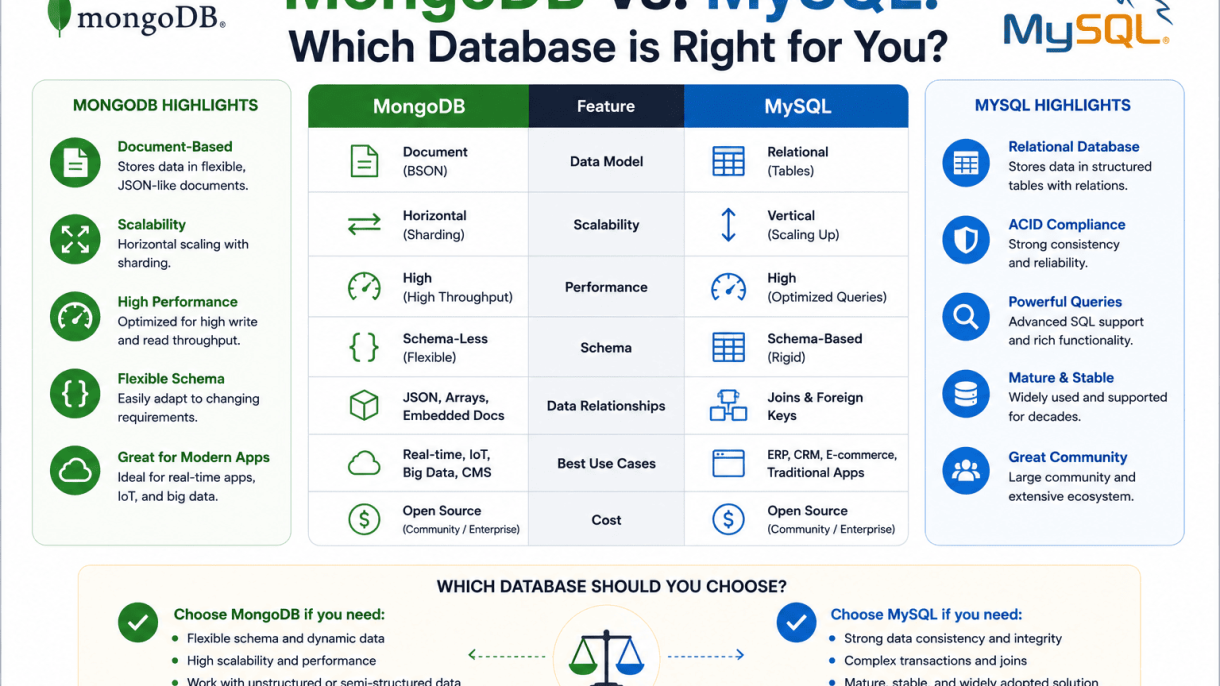

Introduction to MongoDB and MySQL
Choosing the right database is a foundational decision for any application. Two of the most popular options are MongoDB and MySQL, but they represent fundamentally different approaches to data management. MongoDB is a NoSQL document store designed for flexibility and scalability, while MySQL is a relational database management system (RDBMS) built on a structured, table-based model. Understanding their origins, core philosophies, and data models is essential to determining which one fits your project’s needs.
What is MongoDB? The Document Model Explained
MongoDB is a NoSQL database that stores data in flexible, JSON-like documents. Instead of rows and columns, each record is a document—a self-contained unit of data that can have its own structure. This document model allows for nested fields, arrays, and varying schemas within the same collection. For example, a user document might include an array of addresses, each with different fields, without requiring separate tables or joins. Key features include:
- Schema-less design: Documents in the same collection can have different fields, enabling rapid iteration.
- Embedded documents: Related data can be nested within a single document, reducing the need for expensive joins.
- Horizontal scaling: Built-in sharding distributes data across multiple servers.
- Rich query language: Supports filtering, aggregation, geospatial queries, and text search.
MongoDB’s philosophy prioritizes developer productivity and flexibility, making it ideal for applications with evolving data models, such as content management systems, real-time analytics, and IoT platforms.
What is MySQL? The Relational Model Explained
MySQL is a relational database that organizes data into tables with predefined schemas. Each table consists of rows (records) and columns (attributes), and relationships between tables are established through foreign keys. The relational model enforces data integrity using constraints, normalization, and ACID (Atomicity, Consistency, Isolation, Durability) transactions. For instance, an e-commerce system might have separate tables for customers, orders, and products, linked by keys to ensure consistency. Core characteristics include:
- Structured schema: Tables and columns must be defined before data insertion, ensuring uniformity.
- Joins: Related data is retrieved by combining tables using SQL JOIN operations.
- Strong consistency: ACID compliance guarantees reliable transactions, even during failures.
- Vertical scaling: Traditionally scaled by upgrading hardware, though clustering and replication are available.
MySQL’s philosophy emphasizes data integrity, reliability, and standardization, making it a staple for applications requiring strict consistency, such as financial systems, inventory management, and legacy enterprise software.
When Each Database Was Created and Why
MongoDB was first released in 2009 by MongoDB Inc. (then 10gen) as a response to the limitations of relational databases in handling large-scale, unstructured data. The rise of web applications, social media, and big data created a demand for databases that could scale horizontally and handle flexible schemas without the overhead of joins and migrations. MongoDB was designed to meet these needs, offering a document model that aligned with how developers naturally structure data in code.
MySQL, on the other hand, was created in 1995 by Michael Widenius and David Axmark. Its development was driven by the need for a fast, reliable, and open-source relational database that could compete with proprietary systems like Oracle and Microsoft SQL Server. MySQL was built on the relational model, which had been the dominant paradigm since the 1970s, and it gained popularity for its ease of use, performance, and strong community support. Over time, it became the backbone of countless web applications, particularly with the LAMP stack (Linux, Apache, MySQL, PHP/Perl/Python).
The table below summarizes their origins and core philosophies:
| Feature | MongoDB | MySQL |
|---|---|---|
| Release year | 2009 | 1995 |
| Primary motivation | Scalability, flexibility for modern apps | Reliable, open-source relational storage |
| Data model | Document (JSON-like) | Relational (tables, rows, columns) |
| Schema | Dynamic, schema-less | Fixed, predefined |
| Consistency model | Eventual consistency (configurable) | ACID (strong consistency) |
Understanding these foundational differences sets the stage for evaluating which database aligns with your application’s requirements, from data structure to scaling strategy.
Data Modeling and Schema Flexibility
The choice between MongoDB and MySQL often hinges on how each database approaches schema design. MongoDB’s document model offers a dynamic, schemaless structure, while MySQL enforces a rigid, predefined schema. This fundamental difference has profound implications for application development, affecting everything from initial design to long-term maintenance.
MongoDB’s Schemaless Approach and Embedded Documents
MongoDB stores data as BSON documents, typically in JSON-like format. This schemaless design means that documents within the same collection do not need to have identical fields. You can add new fields, remove them, or change their data types without altering a central schema definition. This flexibility is particularly valuable in agile development environments where requirements evolve rapidly. A key feature is the ability to embed related data within a single document, reducing the need for joins. For example, a blog post can contain an array of comments directly:
{
  "_id": 1,
  "title": "Database Design",
  "content": "...",
  "comments": [
    { "user": "Alice", "text": "Great article!", "date": "2025-01-01" },
    { "user": "Bob", "text": "Very helpful.", "date": "2025-01-02" }
  ]
}
This embedding improves read performance by retrieving all related data in a single query. However, it can also lead to data duplication if the same data needs to appear in multiple documents.
MySQL’s Fixed Schema and Normalization
MySQL, as a relational database, requires a fixed schema defined before data insertion. Each table has a predefined set of columns with specific data types and constraints. This rigidity enforces data consistency at the database level, preventing accidental insertion of malformed or incomplete records. MySQL encourages normalization—the process of organizing data to reduce redundancy and dependency. In the blog example, comments would be stored in a separate table linked to posts via a foreign key:
- Posts table: id (INT, PRIMARY KEY), title (VARCHAR), content (TEXT)
- Comments table: id (INT, PRIMARY KEY), post_id (INT, FOREIGN KEY), user (VARCHAR), text (TEXT), date (DATETIME)
This structure ensures that each piece of data is stored only once, which simplifies updates and maintains referential integrity. For instance, updating a user’s name in one place automatically reflects across all related comments.
Trade-offs Between Flexibility and Consistency
The choice between MongoDB’s flexibility and MySQL’s consistency involves clear trade-offs:
| Aspect | MongoDB | MySQL |
|---|---|---|
| Schema changes | Easy; no migrations needed for new fields | Requires ALTER TABLE commands, which can be complex with large datasets |
| Data integrity | Relies on application logic; no built-in enforcement | Enforced via constraints, foreign keys, and data types |
| Query complexity | Simple for embedded data; complex for multi-document joins | Supports powerful JOINs, subqueries, and aggregations |
| Performance with relationships | Fast reads with embedding; potential duplication | Efficient normalization; may require multiple queries or JOINs |
For applications with rapidly changing data structures, such as content management systems or IoT sensor data, MongoDB’s flexibility reduces development friction. Conversely, for systems requiring strict data integrity, like financial transactions or inventory management, MySQL’s fixed schema and normalization provide a reliable foundation. Developers must weigh these factors against their specific requirements for consistency, scalability, and development speed.
Query Language and Developer Experience
Choosing between MongoDB and MySQL often hinges on how each database handles queries and the developer experience it provides. MongoDB uses a flexible, JSON-like query language that aligns with modern JavaScript and Node.js workflows, while MySQL relies on the mature, declarative SQL standard with decades of tooling and best practices. Understanding these differences is critical for teams evaluating productivity, learning curves, and long-term maintainability.
MongoDB Query API and Aggregation Pipeline
MongoDB’s query language is document-oriented and expressed in JSON-like objects, making it intuitive for developers familiar with JavaScript or Python dictionaries. Basic operations like find() and insertOne() feel natural when working with nested data. The Aggregation Pipeline is a powerful framework for transforming and analyzing data in stages, using operators such as $match, $group, and $sort. This pipeline model eliminates the need for complex joins by allowing multi-step data processing within a single query. However, the learning curve can be steep for developers accustomed to relational thinking, especially when dealing with array manipulations or unwind operations. MongoDB’s query language is best suited for applications that require rapid iteration on schema-less data, such as content management systems or real-time analytics.
MySQL SQL Syntax and JOIN Operations
MySQL uses Structured Query Language (SQL), a standardized language that has been the backbone of relational databases for decades. SQL’s declarative syntax—like SELECT, INSERT, and JOIN—is widely taught and documented, making it accessible to a broad range of developers. JOIN operations, including INNER JOIN, LEFT JOIN, and CROSS JOIN, enable efficient combination of data across related tables, which is essential for normalized schemas. MySQL’s query optimizer handles complex joins and subqueries with mature indexing strategies, but writing efficient JOINs requires understanding of relational design and indexing. For developers who need strict data integrity and complex relationships—such as in e-commerce or financial systems—SQL’s clarity and predictability often outweigh the flexibility of JSON-based queries.
| Feature | MongoDB (JSON-like Queries) | MySQL (SQL) |
|---|---|---|
| Query format | JSON-like objects (BSON) | Structured Query Language (SQL) |
| Joins | No native JOINs; uses $lookup in aggregation | Multiple JOIN types (INNER, LEFT, etc.) |
| Learning curve for beginners | Moderate for developers new to document models | Low due to widespread teaching and resources |
| Tooling ecosystem | MongoDB Compass, Atlas, and shell | MySQL Workbench, phpMyAdmin, and CLI |
| Best for | Flexible schemas and nested data | Structured data with complex relationships |
Learning Resources and Community Support
Both databases offer extensive learning materials and active communities. MongoDB provides official documentation, free online courses (MongoDB University), and a large community forum. The aggregation pipeline has specialized tutorials and video series, though advanced topics like sharding or indexing can require deeper study. MySQL benefits from decades of resources: countless books, online tutorials, and Stack Overflow answers covering everything from basic queries to performance tuning. MySQL’s community is one of the largest in open-source, with strong corporate backing from Oracle. For developers transitioning between the two, understanding the conceptual shift from relational normalization to document embedding is key. Both ecosystems also support major programming languages with mature drivers and ORMs, such as Mongoose for MongoDB and Sequelize for MySQL, further reducing the initial learning barrier. Ultimately, the choice depends on your team’s existing SQL proficiency versus willingness to adopt a document-oriented paradigm.
Performance and Scalability
When evaluating MongoDB vs. MySQL, performance and scalability often determine the best fit for your application. Both databases handle growth, but they approach scaling and workload optimization differently. MongoDB excels in horizontal scaling for large, distributed datasets, while MySQL traditionally relies on vertical scaling and replication for reliability. Understanding these differences helps you match the database to your traffic patterns and data volume.
MongoDB’s Horizontal Scaling via Sharding
MongoDB scales out horizontally using sharding, which distributes data across multiple servers (shards). Each shard holds a subset of the data, and a config server manages metadata. This approach allows near-linear performance gains as you add nodes. Sharding is ideal for write-heavy workloads and large datasets that exceed a single server’s capacity.
- Key components: Shards (data storage), config servers (metadata), mongos routers (query routing).
- Shard key: Choose a field that evenly distributes writes and queries (e.g., user ID or timestamp).
- Example command to enable sharding on a database:
sh.enableSharding("myDatabase")
sh.shardCollection("myDatabase.users", { "userId": "hashed" })
Horizontal scaling suits real-time analytics, IoT, and content management systems where data grows unpredictably. However, sharding adds operational complexity, requiring careful shard key design and monitoring.
MySQL’s Vertical Scaling and Replication
MySQL traditionally scales vertically by upgrading hardware (CPU, RAM, SSD). For read-heavy workloads, it uses replication: a primary server handles writes, while replicas serve reads. This setup improves read throughput and provides failover redundancy. MySQL 8.0 also supports Group Replication for multi-primary configurations, but it remains less horizontally elastic than MongoDB.
- Vertical scaling limits: Hardware costs increase non-linearly; single-server capacity caps around 128-256 GB RAM.
- Replication topology: Primary-replica (asynchronous) or Group Replication (semi-synchronous).
- Example command to set up a replica:
CHANGE MASTER TO MASTER_HOST='192.168.1.10', MASTER_USER='repl', MASTER_PASSWORD='secret', MASTER_LOG_FILE='mysql-bin.000001', MASTER_LOG_POS=107;
START SLAVE;
MySQL’s vertical approach works well for e-commerce, financial systems, and applications with predictable growth. It offers strong consistency and mature tooling, but may require application-level sharding for extreme scale.
Read/Write Performance for Typical Use Cases
Performance varies by workload:
| Use Case | MongoDB | MySQL |
|---|---|---|
| Write-heavy (logs, events) | Excellent with sharding; no joins | Good with InnoDB; slower with many indexes |
| Read-heavy (catalogs) | Good with secondary indexes | Excellent with query caching and replicas |
| Complex joins (reporting) | Poor; use aggregation pipeline | Excellent with normalized schemas |
| Real-time analytics | Very good with in-memory storage | Moderate; requires tuning |
MongoDB performs best with document-oriented data and high write throughput, while MySQL excels in transactional consistency and complex queries. For mixed workloads, consider MongoDB for flexible schemas and horizontal scale, and MySQL for strict ACID compliance and relational integrity.
Indexing and Query Optimization
Indexing is the backbone of query performance in any database system. Both MongoDB and MySQL offer robust indexing strategies, but they differ in structure, flexibility, and maintenance overhead. Understanding these differences helps you choose the right database for your workload and optimize query speed without unnecessary resource consumption.
MongoDB Index Types and Compound Indexes
MongoDB supports a variety of index types to accelerate queries on document-based data. The most common is the single field index, which indexes a single field in ascending or descending order. For queries on multiple fields, MongoDB provides compound indexes, where the order of fields matters significantly. A compound index on {status: 1, createdAt: -1} will efficiently serve queries filtering by status and sorting by creation date, but not the reverse. MongoDB also offers multikey indexes for array fields, text indexes for full-text search, geospatial indexes for location data, and hashed indexes for sharding. Each index type has specific use cases and maintenance costs. For example, compound indexes can support multiple query patterns if designed with the ESR rule (Equality, Sort, Range) to maximize coverage. However, every additional index slows down write operations because MongoDB must update each index on inserts and updates. Regular monitoring of index usage is essential to avoid unused indexes that degrade performance.
MySQL B-Tree and Full-Text Indexes
MySQL’s default indexing structure is the B-Tree index, which works well for equality and range queries, as well as sorting. B-Tree indexes are stored in a balanced tree structure, allowing fast lookups and ordered scans. They are ideal for columns with high cardinality, such as user IDs or timestamps. MySQL also supports Full-Text indexes for natural language search on text columns, using inverted indexing to efficiently match words and phrases. Full-Text indexes are only available on MyISAM and InnoDB storage engines (with InnoDB supporting them from MySQL 5.6 onward). Unlike MongoDB, MySQL does not natively support multikey or geospatial indexes, though spatial indexes are available via R-Trees for geometry data. A key optimization technique in MySQL is the use of covering indexes, where all columns in a query are included in the index, avoiding table lookups entirely. However, MySQL’s B-Tree indexes have a maximum key length and can become less efficient with very wide indexes or long string columns. Index maintenance in MySQL involves periodic rebuilding to reduce fragmentation, especially in tables with frequent updates.
Query Profiling and Explain Plans
Both databases provide tools to analyze query performance and identify bottlenecks. In MongoDB, the explain() method returns query execution statistics, including the index used, number of documents examined, and execution time. Use db.collection.explain("executionStats") to see detailed metrics. MongoDB’s profiler, enabled via db.setProfilingLevel(), logs slow queries and can be set to capture all operations or only those exceeding a threshold. In MySQL, the EXPLAIN statement shows how the query optimizer executes a query, including access type (e.g., ALL for full table scan, ref for index lookup), key length, and rows examined. MySQL also offers SHOW PROFILE and performance_schema for deeper analysis. Key differences: MongoDB’s explain plans focus on index usage and document scanning, while MySQL’s emphasize join types and temporary table usage. For both systems, the goal is to minimize the number of rows or documents scanned. Common optimization techniques include adding missing indexes, rewriting queries to use covered indexes, and avoiding functions in WHERE clauses that prevent index usage. Regular profiling and explain plan review are critical for maintaining query performance as data grows.
Transactions and ACID Compliance
When comparing MongoDB vs. MySQL, understanding how each database handles transactions and ACID compliance is critical for applications that require data integrity. ACID stands for Atomicity, Consistency, Isolation, and Durability. These properties ensure that database transactions are processed reliably. MySQL, with its InnoDB storage engine, has long been the standard for ACID-compliant relational databases. MongoDB, originally known for sacrificing multi-document transactions for scalability, has matured significantly since version 4.0 to offer robust transaction support. The choice between them now often depends on the specific consistency guarantees your application requires and the complexity of your data model.
MongoDB Multi-Document ACID Transactions (since 4.0)
MongoDB introduced multi-document ACID transactions in version 4.0, marking a major shift from its document-level atomicity. Previously, MongoDB guaranteed atomicity only for operations on a single document. Now, you can perform reads and writes across multiple documents, collections, and even databases within a single transaction, while maintaining snapshot isolation. This makes MongoDB viable for use cases that demand strong consistency, such as financial systems or inventory management. However, transactions in MongoDB come with performance considerations. They require a replica set (even in development) and can impact throughput if used excessively. Here is a practical example of a multi-document transaction in the MongoDB shell:
// Start a session and transaction
const session = db.getMongo().startSession();
session.startTransaction({
  readConcern: { level: 'snapshot' },
  writeConcern: { w: 'majority' }
});

try {
  const accounts = session.getDatabase('bank').accounts;
  const transfers = session.getDatabase('bank').transfers;

  // Debit from account A
  accounts.updateOne(
    { account_id: 'A' },
    { $inc: { balance: -100 } }
  );

  // Credit to account B
  accounts.updateOne(
    { account_id: 'B' },
    { $inc: { balance: 100 } }
  );

  // Record the transfer
  transfers.insertOne({
    from: 'A',
    to: 'B',
    amount: 100,
    date: new Date()
  });

  session.commitTransaction();
  print('Transaction committed successfully.');
} catch (error) {
  session.abortTransaction();
  print('Transaction aborted: ' + error);
} finally {
  session.endSession();
}
This example demonstrates atomicity across two collections. If any operation fails, all changes are rolled back.
MySQL’s ACID Compliance with InnoDB
MySQL’s InnoDB storage engine is the gold standard for ACID compliance in relational databases. It supports transactions with full atomicity, consistency, isolation, and durability. InnoDB uses a write-ahead logging (WAL) mechanism, known as the redo log, to ensure durability even in the event of a crash. It offers multiple isolation levels, with the default being REPEATABLE READ, which prevents dirty reads and non-repeatable reads. InnoDB also enforces foreign key constraints and referential integrity, which are essential for relational data models. The trade-off is that ACID compliance in MySQL can lead to locking overhead and reduced concurrency under heavy write loads, especially at the highest isolation level (SERIALIZABLE). For most traditional applications, MySQL’s ACID guarantees are reliable and well-understood.
When Transaction Support Matters Most
The need for multi-document or multi-table transactions typically arises in scenarios where data consistency is paramount. Here is a comparison of when each database’s transaction support is most appropriate:
| Use Case | Recommended Database | Rationale |
|---|---|---|
| Financial ledger systems | MySQL or MongoDB | Both offer ACID transactions; MySQL is traditional, MongoDB suits flexible schemas. |
| E-commerce order processing | MySQL | Requires strong referential integrity across orders, customers, and inventory tables. |
| Content management with embedded data | MongoDB | Single-document atomicity often sufficient; transactions needed only for complex updates. |
| High-throughput logging or analytics | MongoDB | ACID transactions are rarely needed; eventual consistency is acceptable. |
| Banking or compliance-critical apps | MySQL | Proven track record with strict audits and mature tooling for ACID enforcement. |
Transaction support matters most when operations must either fully succeed or fully fail without partial updates. For example, transferring funds between accounts, updating inventory after a purchase, or managing reservations all require atomicity. In MongoDB, multi-document transactions are best used sparingly, as they can introduce latency. In MySQL, transactions are a core feature and perform well with proper indexing and isolation level tuning. Ultimately, if your application demands strict consistency across many related tables, MySQL is often the safer choice. If you need schema flexibility and can limit transactions to critical paths, MongoDB’s ACID support is now robust enough for production use.
Security and Authentication
When choosing between MongoDB and MySQL, understanding their security architectures is critical for protecting sensitive data. Both databases offer robust authentication, authorization, and encryption features, but they differ in implementation and default configurations. This section compares their built-in security mechanisms and provides actionable best practices for both systems.
MongoDB Role-Based Access Control and Encryption
MongoDB employs a flexible Role-Based Access Control (RBAC) system that allows granular permission management. By default, MongoDB enables authentication only when explicitly configured, so administrators must activate it during deployment. Key features include:
- Built-in roles: Predefined roles such as
read,readWrite,dbAdmin, anduserAdminfor common use cases. - Custom roles: Create roles with specific privileges on databases, collections, or actions (e.g.,
find,insert,dropCollection). - SCRAM authentication: Default mechanism using salted challenge-response for password verification.
- X.509 certificate authentication: Supports mutual TLS for client and server identity verification.
- Encryption at rest: Native encryption with AES-256-CBC or AES-256-GCM via WiredTiger storage engine, plus field-level encryption for sensitive fields.
- TLS/SSL in transit: Mandatory for production deployments; encrypts all network traffic between clients and servers.
MongoDB also offers LDAP and Kerberos integration for enterprise environments, making it suitable for complex organizational policies.
MySQL User Management and SSL/TLS Support
MySQL provides a mature, SQL-based user management system with fine-grained control over database objects. Authentication is enabled by default, and the mysql.user table stores credentials. Core security components include:
- User accounts: Created with
CREATE USERand assigned passwords usingIDENTIFIED BY; supports caching SHA-2 or native MySQL authentication plugins. - Privilege system: Global, database, table, column, and routine-level privileges (e.g.,
SELECT,INSERT,ALTER,CREATE VIEW). - SSL/TLS encryption: Configurable for client-server connections; requires certificate files and enables
REQUIRE SSLper user or globally. - Transparent Data Encryption (TDE): Available in MySQL Enterprise Edition for encrypting data files at rest.
- Audit log plugin: Logs connection attempts, queries, and administrative actions for compliance.
MySQL also supports proxy users and role-based access (since MySQL 8.0) for simplified privilege management across teams.
Common Security Best Practices for Both
Regardless of which database you choose, the following practices significantly reduce risk:
| Best Practice | MongoDB | MySQL |
|---|---|---|
| Enable authentication | Set security.authorization: enabled in config |
Ensure skip-grant-tables is not set |
| Use strong passwords | Enforce via SCRAM or external auth | Use validate_password plugin |
| Restrict network access | Bind to specific IPs or use firewalls | Bind to 127.0.0.1 or use bind-address |
| Encrypt connections | Enable TLS with net.tls.mode: requireTLS |
Configure ssl-ca, ssl-cert, ssl-key |
| Limit privileges | Assign only necessary roles per user | Grant only required privileges per user |
| Regular updates | Apply MongoDB security patches | Stay current with MySQL patch releases |
| Monitor logs | Enable audit logging via enterprise or open-source tools | Use audit_log plugin or general query log |
Additionally, both databases benefit from principle of least privilege: never use administrative accounts for routine operations. For MongoDB, disable direct server access from the internet; for MySQL, remove anonymous accounts and test databases after installation. Regular security reviews and automated vulnerability scanning further strengthen your database environment against evolving threats.
Ecosystem, Tools, and Cloud Integration
Beyond raw performance and data modeling, the practical success of a database often hinges on its surrounding ecosystem—the tools, drivers, and cloud services that streamline development, administration, and scaling. Both MongoDB and MySQL offer mature ecosystems, but they cater to different workflows and preferences. Understanding these differences helps you choose a database that fits not just your data, but your team’s toolchain and infrastructure.
MongoDB Atlas and Third-Party Integrations
MongoDB’s cloud-native offering, MongoDB Atlas, is a fully managed, multi-cloud database service supporting AWS, Azure, and Google Cloud. It provides automated backups, auto-scaling, global cluster distribution, and built-in visualizations like Charts and Realm for serverless functions. Atlas simplifies operational tasks such as sharding and replica set management through a web UI and API. For third-party integrations, MongoDB connects seamlessly with popular analytics tools (e.g., Tableau, Looker), ETL platforms (e.g., Apache Kafka, Airbyte), and monitoring services (e.g., Datadog, New Relic). The MongoDB Connector for BI enables SQL-based querying against document data, bridging the gap for teams accustomed to relational tools.
MySQL Workbench, phpMyAdmin, and Cloud Offerings
MySQL’s ecosystem is equally robust, centered around two flagship tools: MySQL Workbench and phpMyAdmin. MySQL Workbench is a comprehensive desktop application for database design (ER diagrams), SQL development, administration (user management, backup/restore), and performance tuning. phpMyAdmin, a web-based interface, is a lightweight alternative widely used for rapid database management, especially in shared hosting environments. On the cloud side, major providers offer managed MySQL services: Amazon RDS for MySQL, Google Cloud SQL, and Azure Database for MySQL. These services handle patching, replication, and automated backups, but often require manual scaling or read-replica setup compared to Atlas’s auto-scaling. MySQL also integrates with tools like DBeaver, Navicat, and Percona Monitoring and Management (PMM) for advanced diagnostics.
Language Driver Support (Python, Node.js, Java, etc.)
Both databases provide first-class driver support across all major programming languages, but their design philosophies differ. MongoDB’s drivers (e.g., PyMongo for Python, Mongoose for Node.js, MongoDB Java Driver) are inherently schema-agnostic and map directly to JSON-like documents, simplifying CRUD operations for object-oriented code. MySQL drivers (e.g., mysql-connector-python for Python, mysql2 for Node.js, JDBC for Java) require explicit schema definitions and SQL queries, which can be more verbose but offer stronger type enforcement. The table below summarizes key ecosystem differences:
| Feature | MongoDB | MySQL |
|---|---|---|
| Primary Cloud Service | MongoDB Atlas (multi-cloud, auto-scaling) | Amazon RDS, Google Cloud SQL, Azure Database (manual scaling) |
| GUI Administration Tool | MongoDB Compass (visual schema explorer) | MySQL Workbench (ER diagrams, SQL editor) |
| Web-Based Admin Tool | Atlas Data Explorer (limited) | phpMyAdmin (full CRUD, hosting-friendly) |
| Popular ORM/ODM | Mongoose (Node.js), Morphia (Java) | Sequelize (Node.js), Hibernate (Java), SQLAlchemy (Python) |
| Analytics Integration | MongoDB Charts, BI Connector (SQL-on-Document) | MySQL Analytics Engine, Looker, Tableau (native SQL) |
When evaluating ecosystem fit, consider your team’s familiarity with SQL vs. document-based queries, the need for auto-scaling cloud infrastructure, and the importance of graphical design tools. MongoDB Atlas excels for teams wanting minimal operational overhead, while MySQL’s tools like Workbench and phpMyAdmin offer deep control for relational database veterans.
Use Cases: When to Choose MongoDB vs. MySQL
MongoDB for Real-Time Analytics and Content Management
MongoDB excels in scenarios requiring flexible schemas and rapid ingestion of semi-structured or unstructured data. Its document model allows developers to store JSON-like documents directly, making it ideal for real-time analytics where the data shape evolves frequently. For example, a social media platform tracking user interactions—likes, comments, shares, and clickstreams—can insert millions of events per minute without predefined columns. MongoDB’s aggregation pipeline supports ad-hoc queries on nested fields, such as calculating trending topics or average session duration, without complex joins.
In content management systems (CMS), MongoDB handles diverse content types—articles with embedded images, videos, tags, and metadata—all within a single document. A news website can store an entire article, including author bio, comments, and related links, in one record. This avoids costly joins and speeds up page loads. Common MongoDB use cases include:
- Real-time dashboards for IoT sensor data
- User-generated content platforms (blogs, forums)
- Personalization engines that adapt to user behavior
- Catalog management for e-commerce with varied product attributes
For a practical example, consider inserting a blog post in MongoDB:
db.posts.insertOne({
  title: "MongoDB vs. MySQL",
  author: "Jane Doe",
  tags: ["database", "comparison"],
  content: "Detailed analysis...",
  comments: [
    { user: "Alice", text: "Great article!", date: new Date() }
  ]
})
MySQL for E-Commerce and Financial Applications
MySQL’s relational model enforces strict data integrity through ACID transactions, making it the backbone of e-commerce and financial systems. In an online store, orders, customers, products, and payments are linked by foreign keys. MySQL ensures that a payment is recorded only if the inventory is decremented and the order status updated—all within a single transaction. This atomicity prevents partial updates that could lead to overselling or financial discrepancies.
Financial applications, such as accounting software or banking systems, rely on MySQL’s support for complex queries with joins, aggregations, and subqueries. For instance, generating a monthly statement involves joining transaction tables with accounts and customers, then summing amounts—a task that is straightforward in SQL. Key MySQL scenarios include:
- Inventory management with stock-level consistency
- Order processing pipelines requiring rollback on failure
- Reporting tools that aggregate sales by region or time
- Compliance-driven systems needing audit trails
A typical e-commerce transaction in MySQL might look like:
START TRANSACTION;
UPDATE products SET stock = stock - 1 WHERE id = 100;
INSERT INTO orders (customer_id, product_id, quantity) VALUES (42, 100, 1);
COMMIT;
Hybrid Approaches Using Both Databases
Many modern applications leverage the strengths of both MongoDB and MySQL in a polyglot persistence strategy. For example, a retail platform can use MySQL for transactional order management and financial records, while MongoDB handles product catalog, user reviews, and session data. The two databases can be synchronized via event-driven mechanisms, such as change data capture (CDC) or message queues like Apache Kafka.
A practical hybrid architecture might involve:
- MySQL: Stores customer profiles, payment history, and inventory levels (ACID-critical data)
- MongoDB: Manages product descriptions, images, and real-time analytics (flexible schema)
- Integration: A microservice that updates MongoDB’s product view count whenever a MySQL order is placed
This approach allows each database to do what it does best. MongoDB provides fast reads for content-heavy pages, while MySQL ensures data integrity for transactions. Businesses that adopt hybrid models often report better performance and lower operational complexity than forcing a single database to handle all workloads. The key is to clearly define boundaries—for instance, using MySQL as the system of record and MongoDB as the system of engagement for user-facing features.
Conclusion and Decision Framework
Choosing between MongoDB and MySQL ultimately hinges on your project’s specific data characteristics, operational demands, and future growth trajectory. While both databases are powerful and widely adopted, they excel in fundamentally different contexts. The following framework provides a structured approach to making an informed decision, breaking down the evaluation into three critical dimensions.
Evaluate Your Data Structure Needs
Your data’s inherent shape is the single most important factor. Start by asking: Is my data naturally tabular and relational, or is it document-like and hierarchical?
- Choose MySQL if: Your data has a fixed schema with clear relationships between entities (e.g., customers, orders, products). You need to enforce referential integrity (e.g., a foreign key ensuring an order belongs to a valid customer). Examples include financial ledgers, e-commerce catalogs with rigid categories, and content management systems with strict author-article-taxonomy structures.
- Choose MongoDB if: Your data is semi-structured or unstructured, varies in fields across records, or contains nested arrays and objects (e.g., user profiles with optional preferences, product catalogs with differing attributes per category, real-time analytics events). MongoDB’s document model allows you to embed related data (e.g., an order with its line items inside a single document) rather than splitting it across tables, reducing the need for costly joins.
| Data Structure Type | Recommended Database | Example Use Case |
|---|---|---|
| Strictly relational, normalized schema | MySQL | Accounting systems, inventory management |
| Flexible, evolving schema with nested data | MongoDB | User-generated content platforms, IoT sensor feeds |
| Mixed: some relational, some embedded | MongoDB (with references) | E-commerce with varied product types |
Consider Your Scaling and Consistency Requirements
Next, assess your growth model and tolerance for data staleness. Both databases scale, but they prioritize different trade-offs.
- Scaling approach: MySQL traditionally scales vertically (adding more power to a single server) or via complex horizontal sharding. MongoDB was designed for horizontal scaling from the start, with built-in sharding that distributes data across many commodity servers automatically.
- Consistency vs. availability: MySQL offers strong consistency by default (ACID transactions across multiple tables). MongoDB provides tunable consistency; its default read concern delivers strong consistency for most operations, but you can relax it for higher availability in distributed deployments. If your application requires immediate, absolute consistency (e.g., bank transfers, reservation systems), MySQL is the safer choice. If you can tolerate eventual consistency for better performance and uptime during network partitions (e.g., social feeds, caching layers), MongoDB fits well.
Final Recommendations Based on Project Type
Based on the above evaluations, here are concise recommendations for common project archetypes:
- Traditional web applications (e.g., blogs, forums, small CRM): MySQL. Its mature ecosystem, wide hosting support, and clear relational model make it a predictable, low-risk choice for structured data with moderate traffic.
- Real-time analytics, IoT, or content platforms with diverse data: MongoDB. Its ability to ingest high-velocity, varied data without schema migrations, combined with native horizontal scaling, aligns with agile, data-intensive projects.
- Enterprise applications requiring complex transactions (e.g., ERP, healthcare records): MySQL (or a relational database). The need for multi-row ACID compliance and strict referential integrity favors a relational engine.
- Rapidly evolving startups or MVPs with uncertain schema: MongoDB. The schema flexibility allows you to iterate quickly without costly migrations, and you can later add stronger consistency if needed.
- High-traffic social media or gaming backends: MongoDB. The ability to embed user sessions, leaderboards, and game states into single documents reduces application complexity and improves read performance at scale.
Ultimately, there is no universal “best” database. By systematically evaluating your data structure, scaling needs, and consistency requirements, you can confidently select the tool that aligns with your project’s long-term success. When in doubt, prototype a core feature in both to empirically compare performance and developer experience.
Frequently Asked Questions
What are the main differences between MongoDB and MySQL?
MongoDB is a NoSQL document database that stores data in flexible, JSON-like documents with dynamic schemas, making it ideal for rapid iteration and hierarchical data. MySQL is a relational database management system (RDBMS) that uses structured tables with predefined schemas, primary keys, and foreign keys, enforcing ACID compliance and strong data integrity. MongoDB scales horizontally via sharding, while MySQL typically scales vertically or through replication. MySQL excels in complex joins and transactions; MongoDB offers high write throughput and flexible querying on nested data.
When should I choose MongoDB over MySQL?
Choose MongoDB when your application requires flexible schemas, rapid development with evolving data structures, or handles large volumes of unstructured or semi-structured data. It is well-suited for real-time analytics, content management systems, IoT applications, and projects that need horizontal scaling across distributed clusters. MongoDB’s document model also works well for products with nested data like user profiles or catalogs. If your team is comfortable with JSON and needs high write throughput without complex joins, MongoDB is a strong choice.
When is MySQL a better choice than MongoDB?
MySQL is better when your application demands strong data integrity, complex relationships, and multi-row transactions with ACID compliance. It excels in scenarios like e-commerce platforms, financial systems, and legacy applications that rely on structured data and normalized schemas. MySQL’s mature ecosystem, extensive support for SQL, and robust join capabilities make it ideal for reporting and applications requiring precise, consistent data. If your data model is stable and you need referential integrity, MySQL is the traditional, reliable choice.
How do MongoDB and MySQL compare in terms of performance?
Performance depends on workload. MongoDB often outperforms MySQL in write-heavy, high-throughput scenarios due to its document model and lack of join overhead. It also excels at read operations on nested data. MySQL can be faster for complex queries involving multiple tables and aggregations, especially with proper indexing. Both databases offer caching, indexing, and optimization features. For simple key-value lookups, MongoDB is typically faster; for complex relational queries, MySQL tends to have an edge. Benchmarking your specific use case is recommended.
Which database is more scalable: MongoDB or MySQL?
MongoDB is designed for horizontal scalability out of the box through sharding, distributing data across multiple servers automatically. This makes it easier to scale for large, distributed applications. MySQL traditionally scales vertically (adding more power to a single server) or through read replicas and complex sharding setups, which require more manual management. However, MySQL 8.0 and later have improved scalability features, including group replication and InnoDB clustering. For massive, globally distributed systems, MongoDB typically offers simpler horizontal scaling.
Can I use both MongoDB and MySQL in the same project?
Yes, many applications use a polyglot persistence approach, leveraging MySQL for relational, transactional data (e.g., user accounts, orders) and MongoDB for flexible, high-throughput data (e.g., logs, content, real-time analytics). This hybrid model allows you to benefit from the strengths of each database. However, it increases complexity in data synchronization, consistency, and application logic. Tools like change data capture (CDC) or event-driven architectures can help maintain consistency between the two systems.
What are the licensing and cost differences between MongoDB and MySQL?
MySQL is available under the GNU General Public License (GPL) or via commercial licenses from Oracle. The Community Edition is free, while Enterprise Edition requires a subscription. MongoDB is available under the Server Side Public License (SSPL) for the community version, which imposes restrictions on offering it as a service. Commercial licenses are available from MongoDB Inc. Both have free tiers and paid enterprise options. For self-hosted use, MySQL Community Edition is often more permissive, while MongoDB’s SSPL may require careful legal review if you intend to offer the database as a service.
How do MongoDB and MySQL handle data integrity and transactions?
MySQL with InnoDB storage engine provides full ACID (Atomicity, Consistency, Isolation, Durability) compliance, supporting multi-row transactions, foreign keys, and strict consistency. MongoDB offers multi-document ACID transactions starting from version 4.0, but they are more limited in scope and performance compared to MySQL’s mature transaction support. MongoDB emphasizes eventual consistency by default but can be configured for stronger consistency. For applications requiring strict data integrity and complex transactions (e.g., financial systems), MySQL is generally preferred.
Sources and further reading
- MongoDB Documentation: Introduction to MongoDB
- ACID Transactions in MongoDB – MongoDB Blog
- Sharding in MongoDB – MongoDB Documentation
- MongoDB Server Side Public License (SSPL) – MongoDB
- Polyglot Persistence – Martin Fowler
- MongoDB Indexing Strategies – MongoDB University
- MongoDB Aggregation Pipeline – MongoDB Documentation
- MongoDB Data Modeling – MongoDB Documentation
- MongoDB Atlas (Cloud Database) – MongoDB
- MySQL HeatWave (Cloud Database) – Oracle
Need help with this topic?
Send us your details and we will contact you.