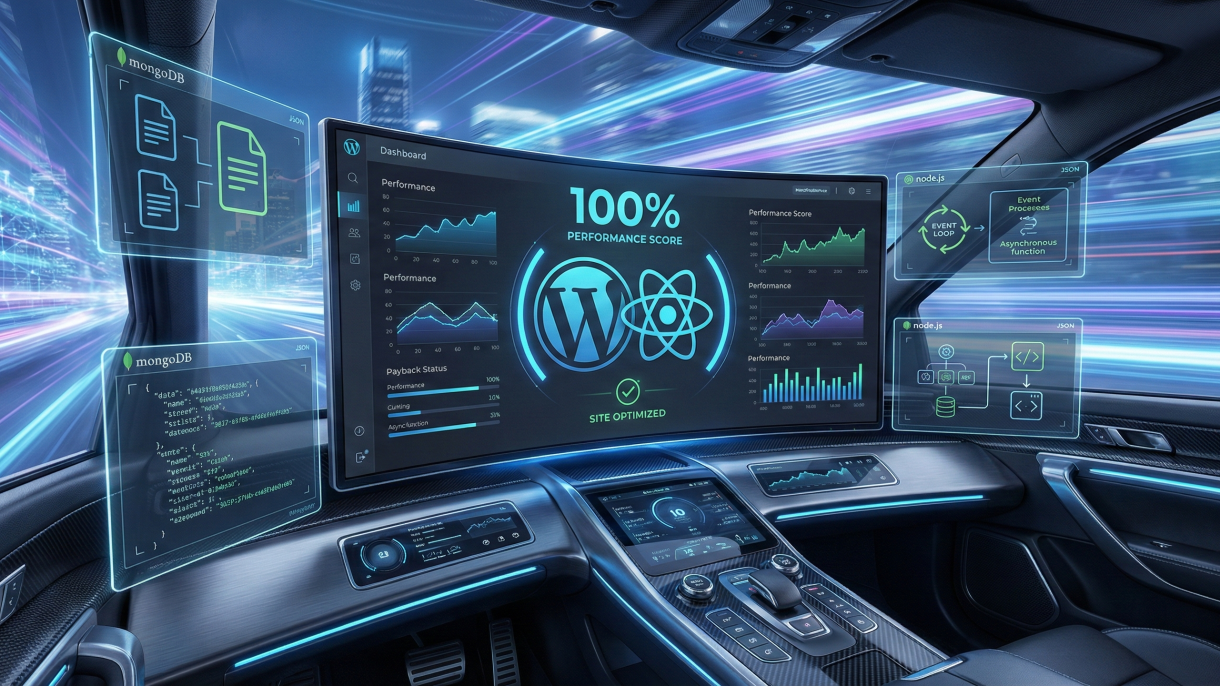

In the modern web landscape, there is often a divide: you are either a “WordPress Developer” or a “Full-Stack Engineer.” However, as a Lead Web Developer for the German compan. I have found that the most powerful solutions exist at the intersection of these two worlds.
While Elementor provides an incredible foundation for rapid UI deployment, my background in the MERN stack (MongoDB, Express, React, Node.js) allows me to break through the limitations that often stop “standard” WordPress freelancers.
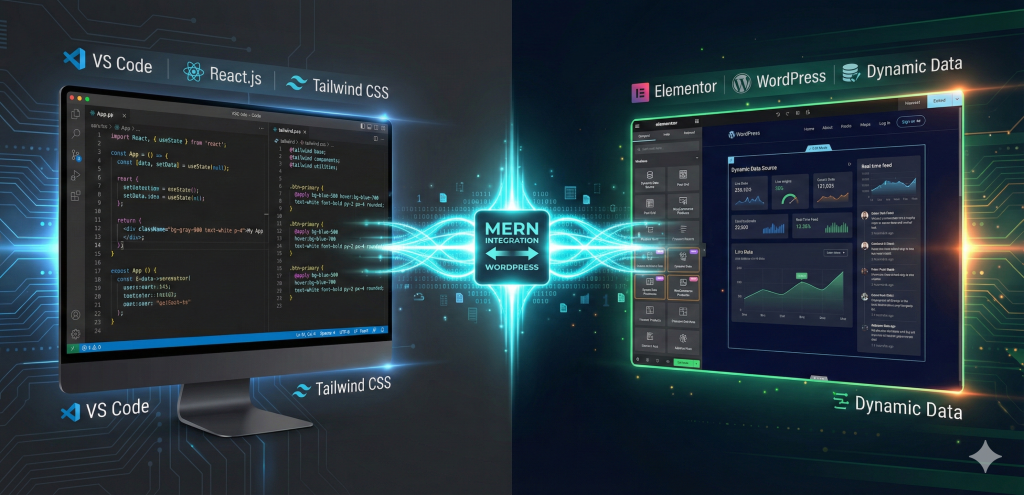
Breaking the “Plugin” Barrier with React
The biggest limitation of a traditional WordPress setup is the reliance on third-party plugins for complex functionality. When a client needs a high-performance interface—such as a real-time data dashboard or a complex multi-step custom calculator—standard plugins often add too much “bloat.”
By leveraging React and Tailwind CSS, I can inject state-driven components directly into an Elementor page. This “hybrid” approach offers:
- Seamless UX: Interfaces that feel like a modern web app without the page refreshing.
- Lightweight Code: Instead of loading a 500KB plugin for a small feature, I write a precise React component that does exactly what is needed.
- Design Consistency: Using my HTML and CSS expertise to ensure the custom React components match the site’s branding perfectly.
A programming language is for thinking about programs, not for expressing programs you’ve already thought of. It should be a pencil, not a pen
2.Scalable Data with Node.js and MongoDB
For data-heavy projects, such as the automated automotive marketplace I developed, the standard WordPress database (MySQL) can sometimes struggle with high-frequency updates.
This is where my MERN skills provide a distinct advantage. I use Node.js to handle heavy server-side tasks, such as fetching thousands of car listings from mobile.de via API. In some cases, offloading non-relational data to MongoDB ensures that the frontend remains lightning-fast, even when processing massive amounts of inventory.
Case Study: Beyond Simple Design
- API Integration: Successfully implemented bi-directional sync for industrial platforms
- Automation: Developed systems for FairMart.lk and room rental sites that sync directly with platforms like Airbnb.
- Enterprise Standards: Working within a German agency environment requires a deep understanding of clean code, performance, and scalability—skills I honed during my BSc in Computer Science.
Why This Approach is the Future of Web Development
Clients today don’t just want a digital brochure; they want a business tool. By combining the speed of WordPress/Elementor with the power of React and Node.js, I provide a solution that is:
- Easy to Manage: Marketing teams can still use Elementor to edit content.
- Engineered for Growth: The backend is built by a developer who understands architecture, not just “drag-and-drop”.
- Future-Proof: Using modern stacks like Firebase and React means the site is ready for whatever comes next in the tech world.
Case Study: Beyond Simple Design
My journey from a freelance designer on Fiverr to a Lead Developer in Dhaka and now Germany has taught me one thing: the best tech is the one that empowers the user. Building your brand as Azim Uddin means delivering that power through expert engineering.